
Detailed guide for MVP development
What is an MVP (Minimum Viable Product)?
An MVP is the simplest version of a product that includes only the core features necessary to address the initial needs of early adopters and gather valuable feedback. The primary goal of an MVP is to test and validate a product or business idea with minimal development effort and resources. It serves as a foundational step in the product development process, allowing for iterative improvements based on user feedback.
Right approach to build MVP.
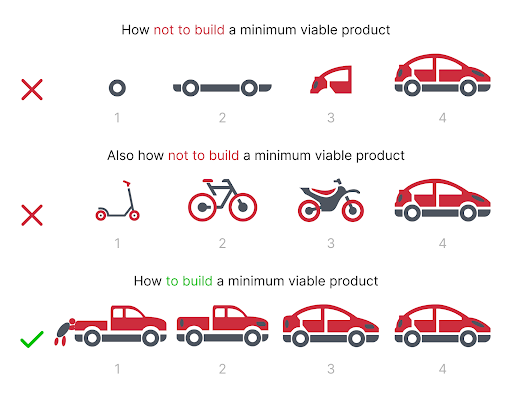
MVP should give the ability to test if the product should be built at all.
1st approach: In a traditional waterfall project, the individual components or stages do not yield value independently; it is only the final product that brings value. This approach stands in contrast to the concept of an MVP.
2nd approach: The MVP principle requires that each successive version builds upon the previous one, fostering an evolutionary progression. Instead of replacing solutions, the emphasis is on the ongoing evolution of the product. Replacing solutions not only wastes the time, resources, and effort invested in setup and user training but also disrupts the product’s natural development.
3rd approach: A true MVP follows this pattern: In the initial phase, we create a basic concept. While it may lack advanced features, it should still deliver value and provide a preview of the final solution’s appearance. As we advance through subsequent stages, we introduce modules and features. These components remain adaptable, open to modification or replacement in response to our evolving needs and accumulated experience.
MVP DEVELOPING
Developing a Minimum Viable Product (MVP) is a strategic approach to building a product with the minimum set of features required to satisfy early users and gather feedback. Here’s a detailed guide for MVP development:
1. Define Your MVP Goals:
Start by clearly defining the primary objectives and goals of your MVP. This is the foundation of your entire project. Consider these aspects:
- Problem Statement: What specific problem or pain point is your MVP aiming to address? It’s crucial to have a deep understanding of the problem you’re solving for your target audience.
- Goals and Objectives: What are the specific outcomes you want to achieve with your MVP? For example, it could be increasing user engagement, reducing customer support requests, or generating revenue.
- Key Performance Indicators (KPIs): Determine the metrics you’ll use to measure the success of your MVP. These might include user acquisition, user retention, conversion rates, or revenue growth.
- Make sure your MVP goals are SMART: Specific, Measurable, Achievable, Relevant, and Time-bound.
2. Identify Your Target Audience:
It’s crucial to identify and understand your target audience thoroughly. Your MVP should cater directly to their needs and preferences.
Here’s how to do it:
- User Personas: Create detailed user personas representing your ideal customers. Include demographics, behaviors, goals, and pain points. This helps you empathize with your users.
- Market Segmentation: Segment your potential user base into groups with similar characteristics or needs. This allows you to tailor your MVP to specific market segments.
- User Interviews and Surveys: Conduct interviews and surveys to gather insights directly from your target audience. Ask about their problems, desires, and preferences related to your product or service.
3. Market Research:
Thorough market research is essential to understand the competitive landscape and your product’s potential market.
Here’s how to approach it:
- Competitor Analysis: Identify your main competitors in the market. Analyze their products, strengths, weaknesses, pricing strategies, and customer feedback. Identify gaps in their offerings that your MVP can fill.
- Market Size and Trends: Research the overall market size and growth trends. Understand if the market is expanding, contracting, or undergoing significant changes.
- SWOT Analysis: Conduct a SWOT analysis (Strengths, Weaknesses, Opportunities, Threats) to assess your product’s position in the market and identify areas of opportunity.
- Regulations and Compliance: Be aware of any industry-specific regulations or compliance requirements that may affect your MVP’s development or deployment.
The goal of market research is to gain a comprehensive understanding of your industry, competition, and potential customers. This knowledge will guide your MVP development and help you make informed decisions throughout the process.
Remember that the information gathered during these initial steps will lay the foundation for the development of your MVP and its eventual success in the market. It’s essential to be thorough and precise in your research and goal-setting to ensure your MVP aligns with user needs and market realities.
4. Prioritize Features:
After understanding your target audience and conducting market research, you’ll likely have a list of potential features and functionalities for your MVP. The key here is to prioritize them effectively:
- Must-Have Features: Identify the core features that are essential for solving the primary problem or addressing the key pain point for your users. These are the features that should be included in your MVP.
- Nice-to-Have Features: List down additional features that would enhance the user experience but are not critical for the MVP’s initial version. These can be considered for future iterations.
- Technical Feasibility: Assess the feasibility of implementing each feature within the desired timeframe and budget. Some features may require more resources or time to develop.
You can use techniques like the MoSCoW method (Must-Have, Should-Have, Could-Have, Won’t-Have) to categorize and prioritize features effectively.
5. Create a Lean Canvas:
A Lean Canvas is a one-page business model that helps you crystallize your MVP strategy. Here’s how to create one:
- Problem: Clearly state the problem or need you’re addressing with your MVP.
- Solution: Describe your MVP’s solution or how it will address the problem.
- Unique Value Proposition (UVP): Highlight what sets your MVP apart from existing solutions or competitors.
- Customer Segments: Identify your target customer segments.
- Channels: Describe how you’ll reach and acquire customers.
- Revenue Streams: Outline your monetization strategy, even if it’s just a hypothesis for now.
- Cost Structure: Estimate the costs associated with developing and running your MVP.
- Key Metrics: Define the critical metrics you’ll track to measure success.
6. Develop a Prototype:
Before diving into full-scale development, create a prototype or wireframes to visualize the user interface and user experience (UI/UX). Prototyping tools like Figma, Sketch, or even paper sketches can be used for this purpose.
- User Flow: Design the user journey through your MVP, considering how users will navigate and interact with it.
- Mockups and Wireframes: Create detailed mockups or wireframes of key screens and features to illustrate the MVP’s functionality.
- Usability Testing: Conduct usability testing with potential users to gather feedback on the prototype. This helps identify design flaws and usability issues early on.
A well-designed prototype serves as a valuable communication tool for your development team, investors, and stakeholders. It clarifies the product’s vision and functionality before actual development begins.
By following these steps, you’ll be well-prepared to move into the development phase of your MVP, with a clear set of prioritized features and a solid understanding of your target audience and market dynamics.
7. Build the MVP:
With a clear list of prioritized features and a prototype in hand, you’re ready to start building the MVP. Here’s how to proceed:
- Development Team: Assemble a development team with the necessary skills and expertise. This typically includes developers, designers, and QA testers.
- Choose the Right Technology: Select the appropriate technology stack and tools for your MVP. Consider factors like scalability, platform compatibility, and development speed.
- Version Control: Implement version control systems like Git to track code changes and collaborate effectively among team members.
- Continuous Integration and Continuous Deployment (CI/CD): Set up CI/CD pipelines to automate testing and deployment, ensuring a streamlined development process.
Focus on building the core features of your MVP, keeping it as lean and efficient as possible.
8. Keep It Simple:
It’s crucial to maintain simplicity throughout the development process:
- Feature Creep: Be vigilant about feature creep, which occurs when additional, non-essential features are added during development. Stick to the prioritized feature list.
- Minimal Viable Product: Continually refer back to the definition of an MVP. The goal is not to build an all-encompassing product but a lean solution that addresses the core problem.
- User-Centric Design: Ensure that every feature adds value for your target users. Avoid overloading the MVP with features that don’t directly serve user needs.
9. User Testing (closed testing):
Testing your MVP with real users is a critical step to gather feedback and identify areas for improvement:
- Usability Testing: Have users interact with your MVP to evaluate its user-friendliness, navigation, and overall experience.
- Bug Testing: Conduct thorough testing to identify and fix any bugs or technical issues.
- Feedback Collection: Encourage users to provide feedback on their experience, pain points, and suggestions for improvement.
- Iterate Based on Feedback: Use the feedback collected to make necessary improvements and refinements to the MVP.
Iterate through the testing and feedback process multiple times, aiming to enhance the MVP with each iteration. This user-centric approach ensures that your product aligns with user expectations and needs.
These steps set the foundation for a successful MVP development process. Building the MVP itself and gathering user feedback are pivotal stages in bringing your product to market and refining it based on real-world usage and insights.
10. Collect Data and Analytics:
Implement analytics tools to collect data on user behavior and engagement within your MVP. Some key points to consider:
- User Metrics: Track metrics such as user acquisition, user retention, conversion rates, and user engagement. Analyze how users are interacting with your MVP.
- Funnel Analysis: Create funnels to understand the user journey through your MVP. Identify drop-off points where users abandon the product.
- Feedback Integration: Integrate user feedback from various sources, including direct user input, support tickets, and social media.
- A/B Testing: Conduct A/B tests to compare different variations of features or designs to determine which ones perform better.
11. Iterate and Refine:
Based on the data and insights gathered from user testing and analytics, it’s time to iterate and refine your MVP:
- Prioritize Enhancements: Prioritize the most critical improvements based on user feedback and data analysis. Focus on addressing pain points and enhancing user satisfaction.
- Agile Iterations: Use agile development methodologies to implement these improvements in small, frequent iterations.
- User-Centered Design: Continue to keep the user at the center of your decision-making process. Regularly solicit user feedback and make data-driven design choices.
12. Scalability Considerations:
While your MVP may have been designed for simplicity and efficiency, it’s essential to consider scalability for future growth:
- Infrastructure Scalability: Ensure that your technical infrastructure can accommodate a growing user base and increased data volume. Consider cloud-based solutions for scalability.
- Performance Optimization: Continually optimize the performance of your MVP to handle increased traffic and usage.
- Security and Compliance: As you scale, pay attention to security measures and compliance requirements that may become more critical.
- Resource Planning: Plan for additional resources, both in terms of technology and personnel, as your MVP gains traction and scales up.
By implementing data-driven decisions, iterative development, and scalability considerations, you’ll be better equipped to evolve your MVP into a robust and successful product that can meet the demands of a growing user base and market.
13. Develop a Minimal Viable Brand (Brand marketing):
While your primary focus is on the product itself, establishing a basic branding identity can be beneficial:
- Logo: Create a simple and memorable logo for your MVP. It doesn’t need to be elaborate but should represent your product’s identity.
- Landing Page: Develop a basic landing page or website that introduces your MVP to potential users. Include essential information and a call-to-action for early sign-ups or downloads.
- Visual Identity: Choose a color scheme and typography that aligns with your brand. Consistency in design elements helps build recognition.
- Messaging: Craft concise and compelling messaging that communicates your MVP’s value proposition to users.
14. Launch and Gather Feedback:
Launch your MVP to a small, targeted audience or within a specific market segment. During the launch phase:
- User Onboarding: Ensure that user onboarding is smooth and user-friendly. Provide guidance and support for new users.
- Feedback Collection: Encourage users to provide feedback through in-app prompts, surveys, or direct contact. Actively seek insights into their experiences.
- Bug Monitoring: Continuously monitor for any technical issues or bugs that may arise during the initial launch. Have a plan in place for addressing them promptly.
Marketing and Promotion: Promote your MVP through marketing channels appropriate to your target audience. Consider leveraging social media, email marketing, and partnerships.
15. Iterate Again:
After the initial launch and feedback collection phase, it’s essential to iterate on your MVP once more:
- Feedback Analysis: Analyze the feedback received from early users. Identify recurring themes, pain points, and opportunities for improvement.
- Prioritize Enhancements: Prioritize the most impactful improvements based on user feedback and the evolving market landscape.
- Continuous Development: Implement these enhancements through iterative development cycles, maintaining an agile approach.
- User Growth: As your MVP improves and evolves, focus on user growth strategies to expand your user base. Consider scaling marketing efforts and user acquisition tactics.
By launching your MVP with a minimal viable brand, actively gathering feedback, and continuously iterating based on user input and market dynamics, you set the stage for the ongoing success and growth of your product. These steps help you refine your MVP into a more mature and user-centric solution.
16. Monitor Key Metrics:
As your MVP gains traction and usage increases, it’s crucial to closely monitor key performance metrics:
- User Acquisition: Track how users are discovering and signing up for your MVP. Identify which acquisition channels are most effective.
- User Retention: Measure user retention rates to assess how well your MVP keeps users engaged over time.
- Conversion Rates: Analyze conversion rates at various stages of the user journey to pinpoint areas of improvement.
- Revenue Generation: If applicable, monitor revenue generation and assess the effectiveness of your monetization strategy.
17. Seek Funding (If Needed):
If your MVP has demonstrated value and potential for growth, consider seeking additional funding to scale your operations and reach a broader audience:
- Pitch to Investors: Prepare a compelling pitch and business plan to present to potential investors, including venture capitalists, angel investors, or crowdfunding platforms.
- Bootstrapping: Alternatively, if you’re financially capable, you may choose to bootstrap your MVP’s growth, reinvesting revenue to fund expansion.
18. Build a Roadmap:
Develop a product roadmap that outlines your MVP’s future development path. The roadmap should:
- Specify Upcoming Features: Clearly define the features and enhancements planned for upcoming iterations.
- Set Timelines: Establish timelines or release schedules for each planned development phase.
- Prioritize Initiatives: Prioritize features and improvements based on user feedback, market trends, and business goals.
19. Plan for Growth:
As your user base and product mature, shift your focus toward sustainable growth strategies:
- User Acquisition: Scale your user acquisition efforts through marketing, partnerships, or referral programs.
- Market Expansion: Consider expanding into new markets or customer segments as opportunities arise.
- Scaling Operations: Ensure that your infrastructure, support, and customer service can handle increased demand.
20. Scale Up:
Gradually add more features and functionalities to your product as you expand your user base and achieve your business objectives.
- Feature Enhancements: Continuously enhance and optimize existing features to meet user needs and maintain a competitive edge.
- User-Centric Development: Keep a user-centric approach by gathering ongoing feedback and incorporating it into your development process.
- Marketing and Promotion: Invest in marketing efforts to promote your MVP to a wider audience and solidify your position in the market.
Remember that MVP development is an ongoing process. As you progress through these final steps, the focus shifts from building the initial product to refining it, scaling it, and maximizing its potential in the market. Stay agile, adapt to changing circumstances, and remain responsive to user feedback to ensure your MVP’s continued success.
MVP Development Costs
The cost of MVP development can vary widely depending on various factors, including the complexity of your project, the features you want to include, the technology stack you choose, and where you source your development talent.
Here are the most significant key factors that influence the cost of MVP and final product development:
- Product type: e-commerce, social app, fitness, CRM, etc.
- Scope and complexity: required features and functionality
- Product UI/UX design: template or custom
- Platforms: Web, iOS, Android, MacOS, etc.
- Technology stack: Some technologies are more expensive due to the availability of skilled developers.
- Development Team: The cost of developers and designers varies based on their experience, location, and type of cooperation
- Backend infrastructure: Is there a need for a backend infrastructure to support app functionality, user and content management, as well as an admin panel for app administration
- Third-party integrations: Are there any integrations needed, and if so, what is their complexity?
- Maintenance, support, and additional services: encompass ongoing efforts to ensure a software product’s functionality, user satisfaction, and adaptability
The average cost to develop and mobile app
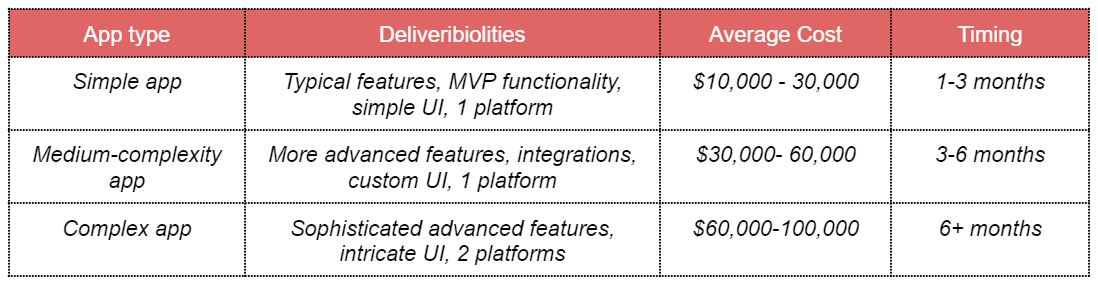
For a comprehensive overview of average app development across various types, consider the following examples by app category. It’s important to note that each of these listed app types necessitates backend development and includes admin panels for user management and in-app content control.
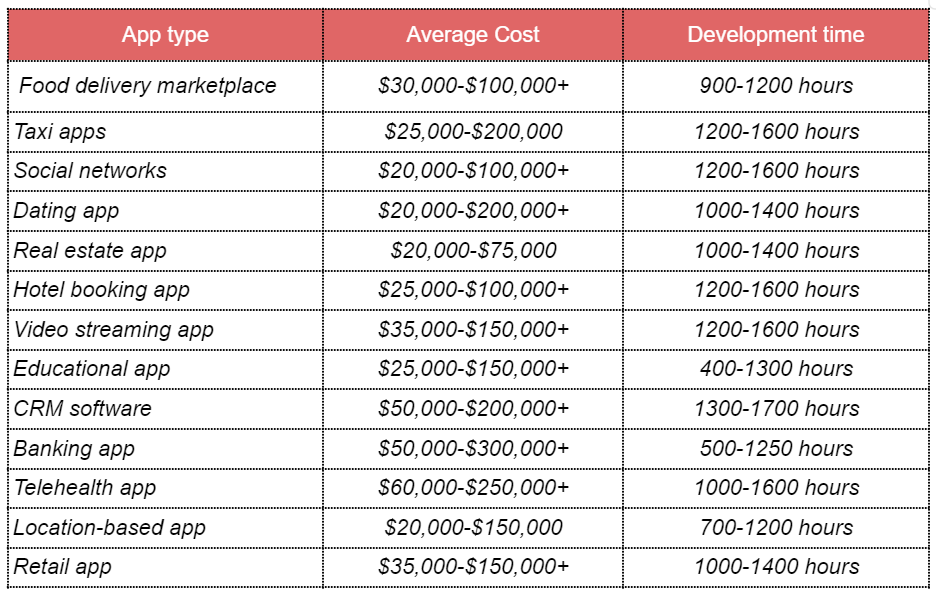
In order to determine the budget for app development, it’s essential to consider key variables that have a substantial impact on the cost:
Team
- Team structure (in-house, outsourced, freelancers)
- Country of developers location
- Copereation model (dedicated team, hourly bases, fixed price)
App platform
- Native app – 1 platform
- Native apps – 2 platforms
- Cross platform or hybrid apps (mobile, desktop, etc)
Development
- Required stages, discovery phase and design complexity
- Number of required features and modules to develop
- Additional requirements : security, encryption, compliance, etc.
- Is there a need for integration with third-party or existing in-house software, and how complex is it
- Data processing, analytics and storage complexity
- QA (Quality Assurance) complexity
Extra cost
- App Store and Google Play charges
- 3rd-party integrations fees (payment gateways comissions, subscriptions, etc.)
- Product administration (admins), marketing, infrastructure cost (hosting, traffic, etc)
- Product support (updates, bug fixing, product improvements)
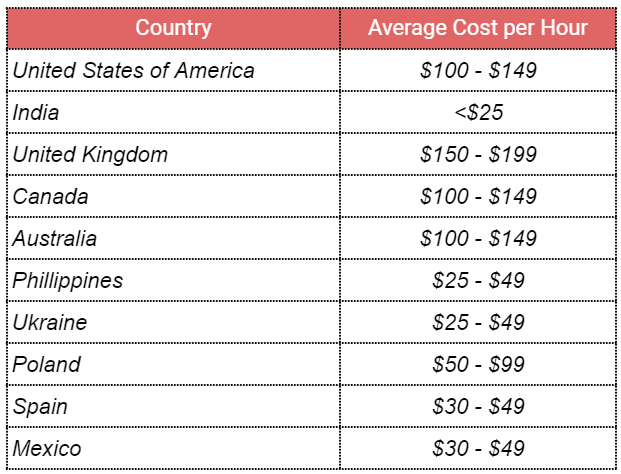
Ultimately, app projects are not uniform in terms of development time or team requirements. It’s essential to recognize that even if we assume consistent app development quality (which is not always the case), the location of the development team has the most significant impact on app development costs. Here are the average development costs per hour across different countries to provide you with valuable insights.
Mobile App Development Pricing by Location
In summary, MVP development is a strategic approach to building apps that allows for cost-effective testing and refinement. From idea conception to product launch, the journey can be complex, but with the right guidance, it becomes navigable. Partnering with an experienced development team like Lab325 can greatly enhance your chances of success in the competitive app market. Our team specializes in not only crafting innovative MVPs but also providing ongoing support for long-term success.
Join us on this journey to learn the essential steps and entrust your vision to Lab325, your dedicated partner in turning app ideas into reality.